
Harnessing unexplored mixed-cultured microbial communities towards development of a cost-effective and low-environmental burden bioprocess
Research members: Masaaki Hosomi PhD., Akihiko Terada PhD., Shohei Riya PhD.
Research fields: Environmental conservation, Process/Chemical engineering, Civil engineering
Departments: Institute of Engineering, Division of Applied Chemistry
Keywords: Environmental Biotechnology, Wastewater Engineering, Bioreactor, Environmental Microbiology, Mitigation of Greenhouse gas emission
Web site:
Summary

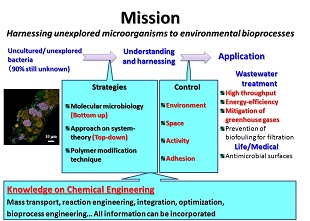
Microorganisms in natural environments are known to be versatile. However, their functions and interactions among different microorganisms have not been unveiled. These unexplored microorganisms have important functions potentials and, therefore, need to be exploited to an engineered system. By integrating mathematical, microbiological and chemical engineering methods, we are tackling on the following missions (Figure 1): (1) attainment of these unexplored microorganisms, to intertwine complicated interactions among microorganisms; and (2) development of a bioprocess allowing to maximize functions. Based on the integrated approach, we are currently developing a cost-effective and energy-efficient biological wastewater treatment system and a bioprocess both to treat wastewater and to convert agricultural wastes into methane gas for energy recovery.
1. Development of a cost-effective wastewater treatment process using aerobic microorganisms and mitigation of greenhouse gases
We are currently developing an aerobic bioreactor system with high cost-effectiveness for nitrogen removal from wastewater. Nitrogen discharge into water bodies leads to eutrophication, which needs to be treated. By managing and controlling microorganism, we are capable of reducing operational cost of nitrogen removal. Via biological nitrogen removal, nitrous oxide (N2O), directly causing global warming and ozone depletion, is produced. We are trying to elucidate mechanisms to produce N2O during nitrogen removal, to acquire microorganisms responsible for N2O reduction and to develop a bioprocess harnessing these microorganisms.
2. Development of a "co-benefit" system achieving both wastewater treatment and biogas recovery
By mixing livestock wastewater, containing high concentration of nitrogen, with stalls of rice plant and lotus, we are also developing a co-benefit system achieving nitrogen removal from livestock wastewater and biogas recovery from the agricultural wastes (Figure 2). Water content derived from livestock wastewater is absorbed by the agricultural wastes; hence, the nitrogen contents are taken by the wastes, which can be fed as a highly-nutritious fertilizer. We are concomitantly investigating a way to control microbial consortium in a dry-thermophilic anaerobic digestion tank (Figure 2) to attain stable biogas production.
Reference articles and patents
Suenaga T, Nishimura M, Yoshino H, Kato H, Nonokuchi M, Fujii T, Satoh H, Terada A, Hosomi M. 2015. High-pressure jet device for activated sludge reduction: Feasibility of sludge solubilization. Biochemical Engineering Journal 100(0):1-8.
Riya S, Muroi Y, Kamimura M, Zhou S, Terada A, Kobara Y, Hosomi M. 2015. Mitigation of CH4 and N2O emissions from a forage rice field fertilized with aerated liquid fraction of cattle slurry by optimizing water management and topdressing. Ecological Engineering 75:24-32.
Terada A, Sugawara S, Yamamoto T, Zhou S, Koba K, Hosomi M. 2013. Physiological characteristics of predominant ammonia-oxidizing bacteria enriched from bioreactors with different influent supply regimes. Biochemical Engineering Journal 79:153-161.
Terada A, Lackner S, Kristensen K, Smets BF. 2010. Inoculum effects on community composition and nitritation performance of autotrophic nitrifying biofilm reactors with counter-diffusion geometry. Environmental Microbiology 12(10):2858-2872.
Contact
University Research Administration Center(URAC),
Tokyo University of Agriculture andTechnology
urac[at]ml.tuat.ac.jp
(Please replace [at] with @.)