
Study on spatial organization of non-coplanarly accumulated-aromatic rings molecules aiming organic structure materials
Research members: Dr. Akiko Okamoto, Dr. Noriyuki Yonezawa
Research fields: Basic chemistry, Materials chemistry
Departments: Institute of Engineering
Keywords: Non-coplanarly accumulated-aromatic rings molecules, Spatial organization, Molecular design, X-ray crystallography, Dynamic NMR study
Web site:
Summary
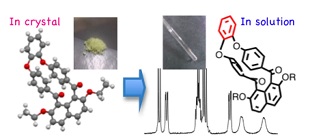
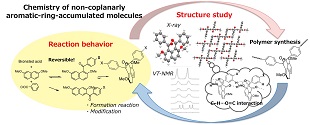
Molecules of congested non-coplanarly-accumulated aromatic rings structure such as binaphthyl and biphenyl have attracted the interests of the chemists in organic chemistry and material chemistry fields as unique building blocks affording characteristic optic and electronic properties in addition to construction of chiral molecular scaffold for organic synthesis. To integrate information about stabilization factors of crystalline accumulation state of organic molecules is significantly important as fundamental study for development of such functional organic materials.
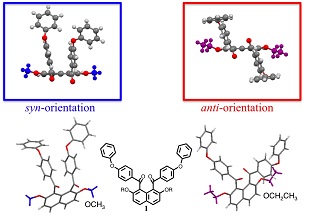
Recently, the authors have reported peri(1,8)-selective diaroylation of naphthalene derivatives. According to the X-ray crystal structure analyses of the resulting 1,8-diaroylnaphthalene compounds, they have been proved to have characteristic structure of non-coplanarly aromatic-rings-accumulated structures. As single molecular structure, two aroyl groups are attached to the naphthalene ring in an almost perpendicular fashion and oriented in an opposite direction. The highly congested circumstance leading non-coplanar spatial organization of aromatic rings accumulation of these molecules means the reduced development of conjugation inevitably resulting in relatively lower contribution of interaction originated from conjugated planes. Instead, it affords the opportunity to reveal the normally hidden interactions. The authors have intended to disclose the stabilization factors of non-coplanarly aromatic-rings-accumulated compounds through investigation of the spatial organization of single molecule, the molecular accumulation structure, and the non-bonding molecular interactions in 1,8-diaroylnaphthalene homologues. In the course of these studies, the authors have designed and synthesized 1,8-diaroylated-2,7-dialkoxynaphthalene compounds followed by determination of the crystal structures, e.g., 1,8-bis(4-fluorobenzoyl)-2,7-dimethoxynaphthalene, 2,7-diethoxy-1,8-bis(4-fluorobenzoyl)naphthalene, 2,7-dibutoxy-1,8-bis(4-fluorobenzoyl)naphthalene, and 1,8-bis(4-fluorobenzoyl)-2,7-diphenoxynaphthalene. In this study, the authors will report crystal structure of peri-aroylnaphthalene copounds and discuss the contribution of the non-bonding molecular interactions to stabilization of the molecular packing through comparison of the crystal structures of the homologues in detail.
Reference articles and patents
1) S. Yoshiwaka, K. Ogata, N. Yonezawa and A.Okamoto*, “Molecular structure of bridged peri-aroylnaphthalene compound having cyclohexane-cis-1,2-dioxy hinge moiety in solution”, European Chemical Bulletin, 2015, 4(4), 195-201.
2) S. Yoshiwaka, D. Hijikata, N. Yonezawa and A.Okamoto*, "Solution structures of bridged peri-aroylnaphthalene compounds having 1,2- or 1,3-benzenedioxy-hinge moiety",
European Chemical Bulletin, 2015, 4(4), 202–206.
3) S. Mohri, S. Ohisa, K. Isozaki, N. Yonezawa and A. Okamoto*,
“Hydrogen bonding between fluoro group and aromatic hydrogen leading stripe structure of R-isomeric column and S-isomeric one: Crystal structure of 2,7-dimethoxynaphthalen-1-yl(3-fluorophenyl)methanone and a comparison with its 1-aroylnaphthalene analogues”, Acta Cryst. Section C (Structure Chemistry), 2015, C71, 344–350.
4) A. Okamoto*, S. Ohisa, S. Yoshiwaka and N. Yonezawa, “Conformational exchange of 1,8-dibenzoyl-2,7-dimethoxynaphthalene analogues in solution”, European Chemical Bulletin, 2015, 4(2), 67-73.
5) S. Yoshiwaka, S. Ohisa, N. Yonezawa and A.Okamoto*, “Synthesis and crystal structure of bridged peri-aroylnaphthalene derivatives”, European Chemical Bulletin, 2014, 3(12), 1142–1147.
6) Akiko Okamoto and Noriyuki Yonezawa, “Unique and Specific Reaction Behavior and Characteristic Spatial Organization of Non-coplanarly Aromatic-ring-accumulated Molecular Compounds”, Journal of Synthetic Organic Chemistry, Japan, 2015, 73(4), 339–360.
Contact
University Research Administration Center(URAC),
Tokyo University of Agriculture andTechnology
urac[at]ml.tuat.ac.jp
(Please replace [at] with @.)